


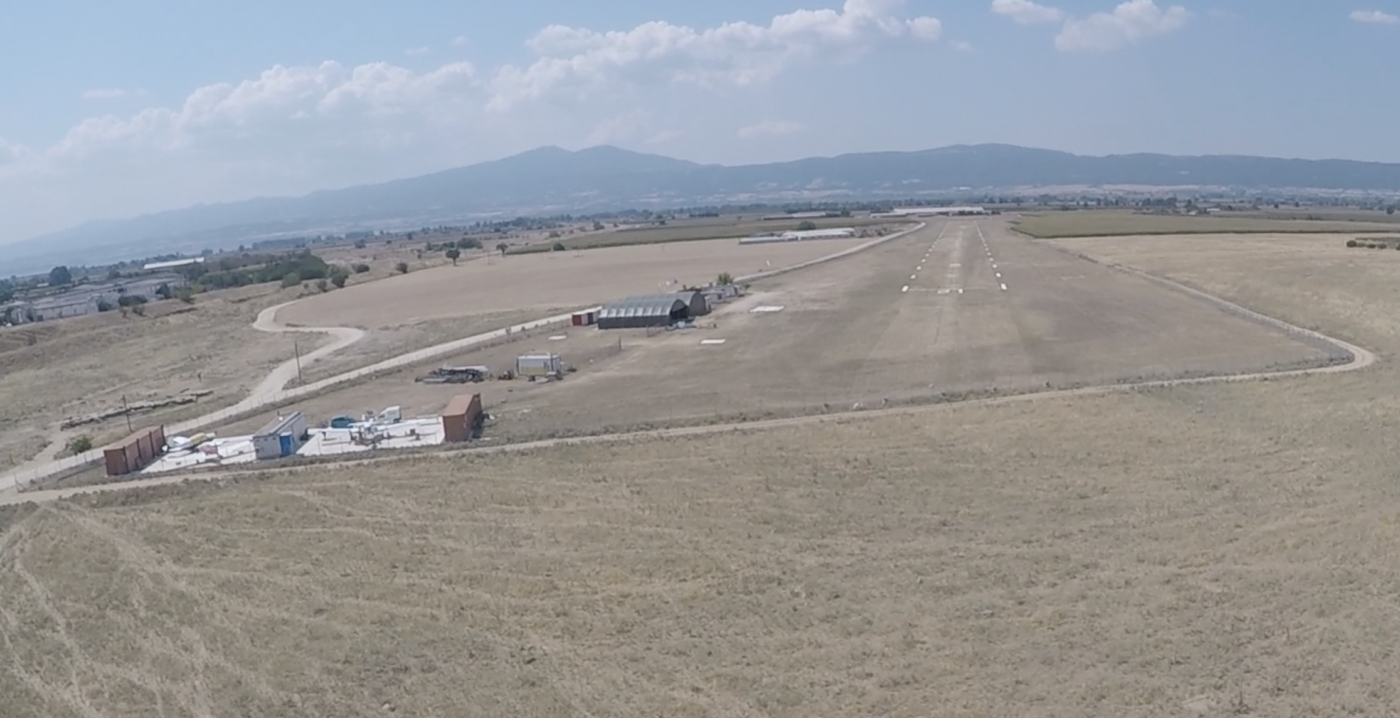
Dear fellow members and pilots, you may avoid flying between 11:00 to 16:00 time due to high temperatures, also you may consider weight & balance as it becomes more important to calculate runway distance needed for take off. Of course all know Kolhiko elevation 375ft and runway optimum length 800 meters. A kind reminder to density altitude to all of us may be very useful these days.
Panos Dangaris
It is the Pressure Altitude, corrected for the deviation of the temperature above or below the standard!
And how is this calculated? Although the mathematical formula for calculating it is quite complex, we can achieve quite high accuracy in the following way:
1. First we calculate the Pressure Height in the following simple way.
From the standard barometric pressure value (ISA = 1013 mB), we subtract the prevailing barometric pressure and multiply the remainder by 30 (the pressure increases or decreases by 1 mB per 30 feet, depending on whether we are ascending or descending). The resulting number is added to or subtracted from the actual altitude, depending on whether it is positive or negative. For example:
Let's assume we want to take off from an aerodrome, the actual altitude of which is 1,000 feet and the barometric pressure given to us by ATIS or the tower is 1010.
So, the pressure altitude is: 1013 – 1010 = +3 x 30 = 90 feet + the 1,000 feet of actual altitude = 1,090 feet!
Now, if the barometric pressure were, for example, 1015, then a negative number would result from subtracting 1013 – 1015 = -2 and so we would subtract 60 feet from the 1,000 feet of actual height, to end up with 940 feet. That is, the pressure height would be lower than the actual height and, therefore, below sea level!
2. Then, we find the temperature deviation from the standard and multiply the difference by 120 (=change in density height per 1 degree Celsius).
Continuing the example above, let's assume that we are given the prevailing temperature at the airport in question as 35°C. So, because our airport is at 1,000 feet, the typical temperature should be 15 – 2 = 13°C (a temperature change of 2°C per 1,000 feet). So we see that we have a deviation equal to 35 – 13 = 22 degrees x 120 = 2,640 feet.
3. End, we add up the pressure height with the deviation from the standard temperature and we find that the density height is: 1.090 + 2.640 = 3,730 feet!
So our plane, even though it is at an actual altitude of 1,000 feet, will behave as if it is at 3,730 feet!!!
Consequently, when I look up the performance in my airplane manual, I will look at the tables with the data that apply to the altitude of 3,730 feet!
It is now understood that, at this height, we must take into account the following factors:
The lift produced by the wings will be reduced due to the thinner atmosphere.
The propeller efficiency will be reduced, since the propeller is also a rotating wing.
The engine performance will be reduced due to fewer oxygen molecules.
All this will have the following consequences:
The plane will accelerate more slowly because reduced performance of the engine and we will need more runway distance to reach takeoff speed. Will the runway length be enough for us?;
We will need to develop higher true speed to produce the required lift, but also to stay in the air after takeoff without stalling. So, even more runway distance.
The rate of rise will be reduced due to lower engine performance and lower wing lift. This can put us in immediate and high danger if there are hills or mountains near the runway extension!
The operational roof of the airplane will be significantly reduced and we may not be able to cross some mountains on our way. So, if we assume that an airplane with an operational ceiling of 12,000 feet starts from an a/d at sea level (e.g. LGTS) on a day when the density altitude has been calculated at 2,000 feet, this airplane will be able to reach up to 10,000 feet of actual altitude!!!
Finally, two more factors that significantly affect the performance of the airplane are weight and humidity. Thus, before we begin our flight, especially to small airports, we should always keep in mind that altitude, temperature, humidity and weight are factors that, to a significant extent, negatively or positively affect the performance of our airplane and will determine whether we will manage to fly safely to our destination or not.
Happy and safe flights!
